


This post builds on our paper “A Language Model from 1913: Pretraining on Historical Text”, accepted to the EMNLP 2026 Main Conference and co-authored by Xiaoxi Luo, Zachary Shinnick, Niclas Griesshaber, Yixuan Wang, Junchi Yu, Freda Shi, Philip Torr, and Yao Lu.
In this post, we 1) explain what History Language Models are and explore some of their applications, 2) describe the challenges we faced in creating TypewriterLM, our own History Language Model, and 3) discuss what may help advance this emerging field.
1) History Language Models and their Applications
Why do we not simply prompt a modern large language model (LLM) to imagine it is in 1913? Because it has already learned about what happened after 1913 during training. It cannot unlearn what it has seen, even if we ask it to pretend otherwise.
By contrast, the defining feature of History Language Models is that they are designed to be trained only on texts published before a “historical” cutoff date. For example, our TypewriterLM has a cutoff date of 1913. Some examples of what this could enable for historical research and AI for Science include:
Retrospective Forecasting: We could ask a History Language Model with a 1913 cutoff: “Do you think there will soon be a major war in Europe?”
Historical Decision-Making: Instead of asking the model to predict what happens next, we could give it new information and ask how it would respond at a turning point in history: “You are the British Prime Minister. Germany has just invaded Luxembourg. What options do you consider and what course of action will you take?” This would be particularly interesting with models whose training data could be tailored to a specific historical situation. For example, we could train a History Language Model exclusively on British texts published up to 1913 and then fine-tune it on material from the British Prime Minister, such as his public speeches, to make the model better reflect his language and views.
Text-as-Data Applications with Historical Priors: Modern LLMs are already being used to classify or score historical texts. For example, they can measure how much fear is expressed in newspaper articles from 1913. These scores can then be used to construct a fear index over time. But modern LLMs may interpret fear differently from readers in 1913. Comparing their scores with those of History Language Models could reveal how the same newspaper articles may have been interpreted differently in the past, as present-day knowledge and values may shape our reading of historical documents.
The AGI Einstein Test: An unreleased OpenAI model has produced a proposed solution to a Millennium Prize Problem. But could an AI system also make a conceptual leap as big as Einstein’s theory of general relativity using only the information available to him before his breakthrough in 1915?
2) Challenges in Training History Language Models
In our paper, we presented a small number of qualitative examples related to the applications discussed above.
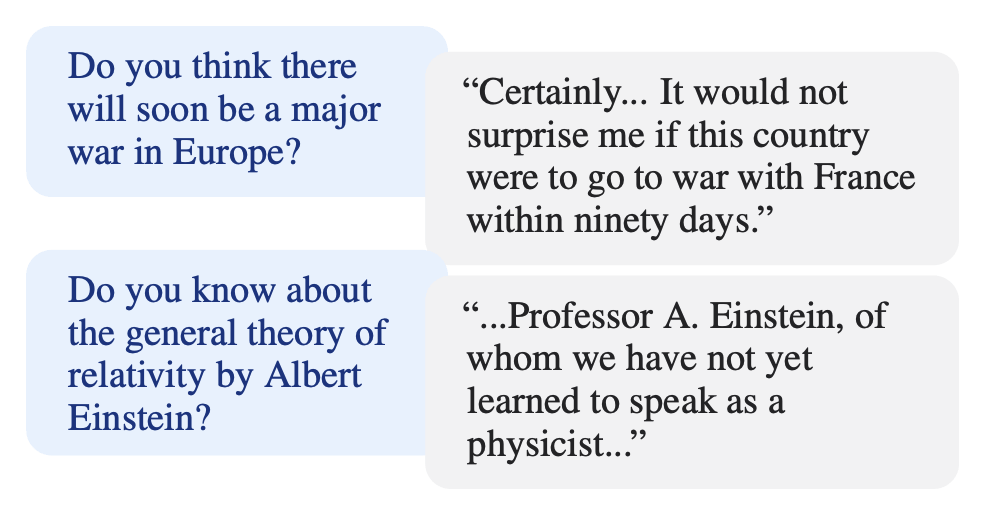
Experimenting with TypewriterLM suggested that more capable History Language Models will be needed before these applications become reliable and useful. Scaling these models further will therefore be necessary, but it will also amplify several of the challenges we encountered when training our 7-billion-parameter TypewriterLM.
Scarcity of Machine-Readable Historical Text Data
Historical texts are not born digital. They first have to be brought from the physical into the digital world by scanning them into formats such as PDFs or image files. Digital libraries then use optical character recognition (OCR) to extract the text into machine-readable formats such as .txt or XML files. For our pretraining corpus, we collected several such datasets that were already available online in a machine-readable form. But the amount of historical text available in this form is still much smaller than the amount of digital text used to train modern LLMs.
Data Leakage in the Historical Pretraining Dataset
The defining feature of History Language Models is that they should only be trained on data from before the cutoff date. But the historical datasets we collected from digital archives can contain errors, for example incorrect publication dates in the metadata. At the scale of billions of tokens, it is impossible to manually check every document to verify that it was actually published before the cutoff date. This makes it very difficult to guarantee that no post-1913 information entered the pretraining dataset. To reduce this risk, we built a filtering pipeline to remove potential sources of leakage from our historical pretraining corpus. In the end, our pretraining corpus consisted of 54 billion historical tokens.
Data Leakage When Teaching the Model to Follow Instructions
Once TypewriterLM had been pretrained on the collected historical datasets, we still had to teach it to answer questions. Pretraining teaches a language model to predict the next token, which allows it to continue sentences, but not to answer questions.
To teach the model some degree of instruction-following, we needed a separate dataset of question-answer pairs for supervised fine-tuning (SFT). Such datasets are relatively scarce in historical sources, so we used Claude to help generate the instructions. This creates another potential source of leakage: even when the SFT dataset is grounded in historical source texts, modern wording or framing may bias the model through the generated instructions.
Compute
Constructing the pretraining and SFT datasets was the foundation, but turning them into a 7-billion-parameter language model required massive compute.
Our academic institutions did not have enough computing capacity to train the model from scratch. Therefore, we applied for external compute and were fortunate to receive access to Isambard-AI, the UK’s most powerful AI supercomputer, hosted by the Bristol Centre for Supercomputing at the University of Bristol.
Benchmarking and Evaluation
Two important dimensions for evaluating History Language Models are their general capability and whether they have learned information from after the cutoff date. Both are difficult to evaluate.
Standard benchmarks are designed for modern LLMs and may favour them because they use modern language and contexts. Therefore, we filtered HellaSwag to remove modern topics and created another version rewritten in historical language. The results showed that a temporal mismatch in language style can itself affect benchmark performance.
We also evaluated whether TypewriterLM had learned information from after 1913 by asking whether it knew major historical events from before and after the cutoff date. We simply measured whether it could recall these events. This evaluation is also only meaningful if the model can reliably recall events before the cutoff date. Otherwise, failure to recall a post-cutoff event could simply reflect poor recall in general rather than the absence of leakage. A separate limitation is that leakage can take the form of any information contained in the training data and may therefore escape a fixed evaluation benchmark.
3) What Could Help Advance the Field
Working Directly with Archives
Physical archives store much more historical text than is currently available in machine-readable form. The US National Archives alone holds billions of pages, but estimates that less than 4% of its physical collection has been scanned.
Of these scans, only a fraction is likely to have been converted into machine-readable text that is readily available for training History Language Models.
The first bottleneck is scanning. Old historical books often have to be restored and prepared before they can be scanned, which can be very expensive. In addition, the scanning process itself is slow because these books are often valuable and must be handled carefully to avoid any damage.
The second bottleneck is converting these scans into machine-readable text. Historical documents vary in fonts, layouts, languages, and handwriting. Because of this heterogeneity, converting historical documents into machine-readable text remains difficult at scale. Frontier vision-language models can now achieve expert-human-level performance on some English historical handwriting and can handle many difficult historical documents, but applying them to enough pages to build a pretraining corpus of billions of tokens would still be prohibitively expensive.
Working directly with archives could therefore create value at two levels. At scale, many such datasets could provide the large amounts of historical text needed to train more capable History Language Models. At the same time, each dataset created from an individual primary source could be highly valuable to historians studying the specific topic, place, institution, or period it covers.
Building an Open Community Around Historical Datasets
Digital archives could make more of their machine-readable historical datasets openly available on platforms such as Hugging Face.
This would allow researchers to combine datasets from different archives to train larger History Language Models. An open community could also help improve these datasets over time by identifying and removing data leakage, correcting metadata, and improving the underlying OCR text if both images and transcriptions are uploaded.
Curating Tightly Controlled Datasets at Scale
Critics may argue that History Language Models will never work as intended because it is impossible to completely control what information enters the training dataset at scale. Even the smallest amount of leakage could matter. For example, in the AGI Einstein Test, even a tiny hint of later knowledge could help the model come up with the theory of general relativity and would therefore create a false positive.
But tightly controlling what information enters the training dataset at scale does not seem to be an inherently unsolvable problem. Frontier LLMs could already be used to go through historical datasets and identify documents that were published after the cutoff date because of incorrect metadata or other errors. They could also flag documents containing concepts or vocabulary that should not appear before the specified cutoff date. This suggests that the problem is tractable. The main challenge is developing a much cheaper filtering pipeline that can operate at scale while being equally or even more effective.
More broadly, controlling what information enters the pretraining corpus at scale is becoming a recognised research direction in machine learning. For example, researchers from Tübingen and Zürich created LittleLearner, a language model trained on a curated corpus designed to exclude “concepts, facts, and vocabulary taught above Grade 5” — essentially a child LLM.
History Language Models may therefore be understood as a subfield within a broader research area that trains language models on tightly controlled training datasets.
Pooling GPU and Data Resources
Several research groups have been working on History Language Models. As these models have to scale to become more useful for the applications discussed at the beginning, their demand for compute will also increase. Academic institutions are often compute-constrained, which limits how quickly these models can be scaled.
One way forward could therefore be to pool GPU resources across research groups working on History Language Models to train larger and more capable models.
Frontier AI labs may also find this area interesting from an interpretability or even commercial perspective. Collaborations between frontier labs, historians, and digital archives could provide the compute and data needed to push this field much further.
History Language Models could then become artefacts that historians study, while history could also help us better understand the limitations of AI.